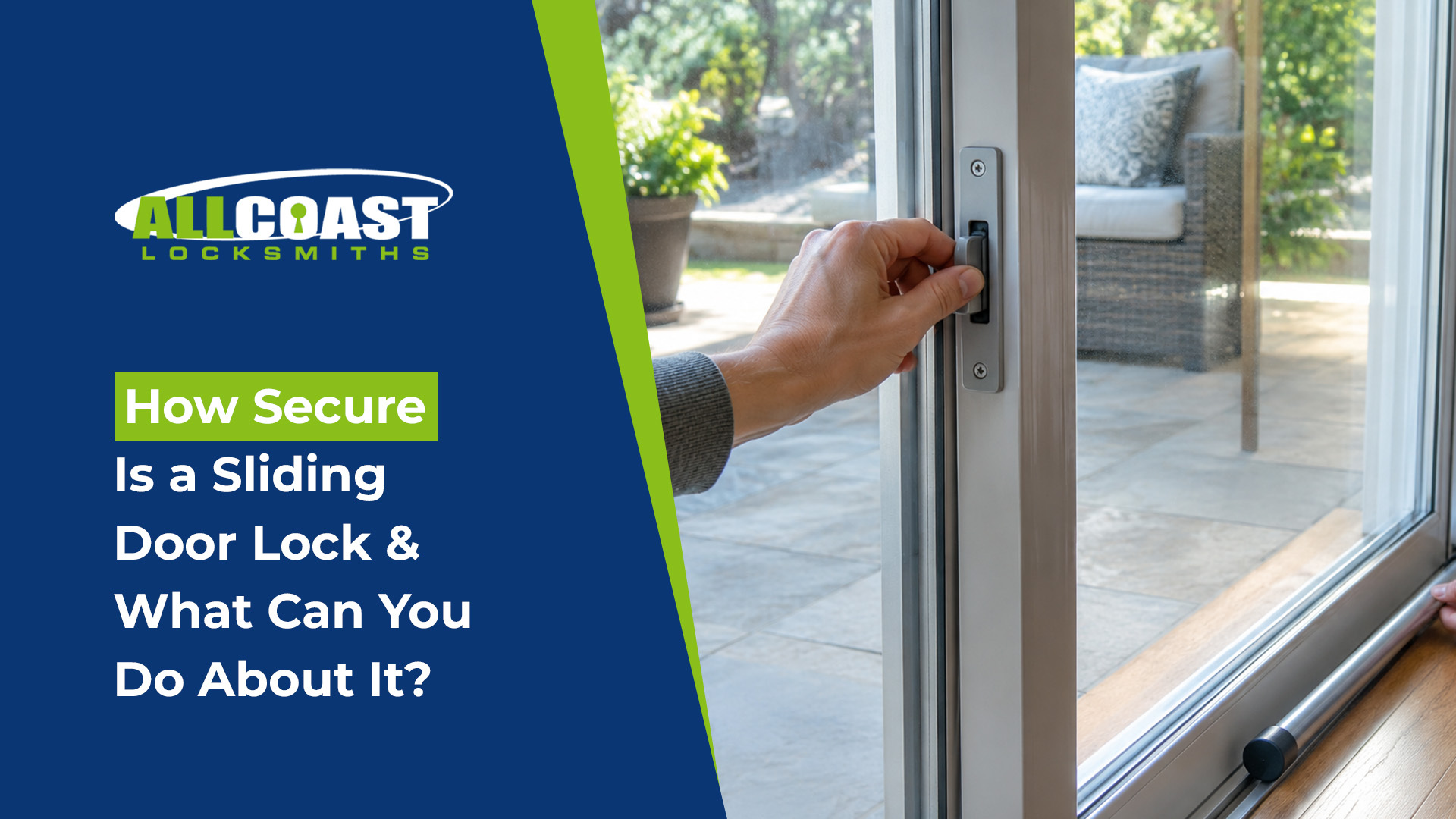
Sliding doors are one of the most common features in Gold Coast homes, and one of the most overlooked security weak points. So how secure is a typical sliding door lock? The honest answer is: not very. Most sliding doors come fitted with a standard latch lock that provides basic closure but minimal resistance to forced entry. The door can often be lifted off its track from the outside, or the latch can be defeated with simple tools in seconds. The good news is that securing a sliding door properly is straightforward and inexpensive, and we walk through exactly what to do.
Why Standard Sliding Door Latches Fall Short
The latch fitted to most sliding doors at the point of installation is designed to keep the door closed, not to provide security. It is typically a simple hook or roller mechanism that engages when the door is pulled shut. Under force, these latches offer very little resistance.
The secondary vulnerability is the track itself. Most aluminium sliding doors can be lifted vertically off the bottom track and pulled outward, bypassing the latch entirely. This is a well known entry method and one that takes very little time or skill to execute.
The Queensland Police Service specifically recommends fitting patio bolts to sliding doors as part of a home security audit, and it is one of the most practical upgrades any Gold Coast homeowner can make.
What a Patio Bolt Actually Does
A patio bolt, sometimes called a Charlie bar or a sliding door security bar, is a secondary locking mechanism that sits in the track of the door and physically prevents it from being slid open. Unlike the standard latch, a patio bolt engages with the frame or floor track and cannot be defeated from the outside without significant force or noise.
A quality patio bolt is one of the most effective and cost efficient security upgrades available for a sliding door. We install them regularly across the Gold Coast as part of our domestic locksmith service and they make a genuine difference.
Preventing the Lift and Pull Entry Method
To address the track vulnerability, there are two practical options. The first is a security pin or anti-lift device fitted to the top of the door frame, which prevents the door from being raised off the track. The second is a track block, which is a simple device that sits in the bottom track and physically stops the door from moving even if the latch is defeated.
Used together, a patio bolt and an anti-lift device close off the two most common methods of forcing a sliding door. Neither is expensive, and both can be installed quickly during a single visit.
What About Sliding Door Locks That Replace the Standard Latch?
There are aftermarket sliding door locks available that replace the standard latch with a more robust keyed mechanism. These offer a meaningful improvement over the factory fitted latch and are worth considering if you want a cleaner solution that does not require a separate patio bolt.
When we assess a sliding door, we look at the condition and quality of the existing latch, the strength of the frame, whether the door can be lifted off the track, and whether there is a security screen in front of it. The right solution depends on the specific door setup, and we will give you a straight recommendation based on what we find.
Security Screens and Sliding Doors
A properly installed security screen door in front of a sliding door adds a significant layer of protection. To be effective, it needs to meet Australian Standard AS5040, which covers the mesh strength, frame integrity, and locking hardware. A standard flyscreen offers no meaningful security and should not be confused with a security screen.
On the Gold Coast, where sliding doors open to outdoor entertaining areas, pools, and balconies, a quality security screen is one of the most practical investments available. It adds security without compromising airflow or the feel of the space.
Rental Properties and Sliding Doors
If you are a tenant and your sliding door has only a standard latch with no secondary lock, you are within your rights to raise this with your property manager. Queensland minimum housing standards require that all external doors have functioning locks, and a standard sliding door latch arguably meets only the bare minimum of that requirement.
The Queensland Government home safety guide recommends securing all doors and windows even when you are at home, which is difficult to do with confidence when your sliding door has only a basic latch. If your property manager is unresponsive to a security concern, the RTA provides a dispute resolution pathway.
We Cover the Full Gold Coast
If your sliding door has only a standard latch, or if you are unsure how secure it actually is, our team can assess it and fit the right solution on the spot. We carry patio bolts, anti-lift devices, and keyed sliding door locks and can advise on security screen options as part of a broader home security review.
Get in touch with our 24 hour locksmith team and we will take a look at what you have and tell you exactly what needs to be done.